Environmental NGOs can now challenge harmful State aid at the EU level!

In 2023, Frank Peters and I published an article on the impact of the Aarhus Convention for the access to justice of NGOs in the Netherlands.[1] Now, almost two years later, the Aarhus Convention keeps on fulfilling its promise: more access to justice for NGOs fighting to preserve our environment – but this time at the European level!
On 12 May, 2025, the European Commission adopted a new Code of Best Practices for the conduct of State aid control procedures, hereafter the Code. In this blog, I shortly explain the concept of State aid, the Code and the importance of this Code for European environmental NGOs.
State aid
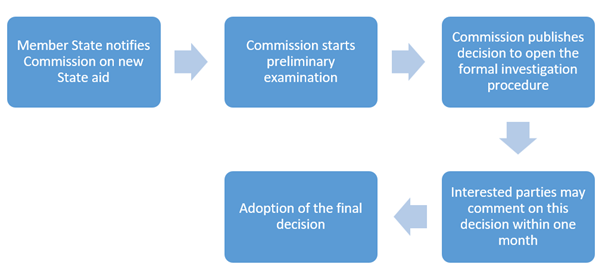
State aid is a form of public subsidies and financial advantage given by the EU Member States to businesses. When a specific business benefits from State aid, it enjoys an advantage over its competitors. State aid may have a negative effect on the internal competition of the European market and is thus in principle prohibited by the Treaty on the Functioning of the European Union (TFEU) pursuant to article 107 TFEU. The TFEU, however, does contain certain exemptions in which State aid is considered compatible with the internal market, such as when it concerns aid to promote the development of disadvantaged areas or for services of general economic interest or aid for the development of small and medium-sized enterprises. Pursuant to article 108 TFEU, Member States must inform the Commission of proposed aid measures. The Commission has to review (the proposed) State aid granted by Member States, to ensure that it does not distort competition. The State aid decision-making process can be illustrated as follows:[2]
The Code
Until recently, only interested parties could submit complaints against the final decision of the Commission. However, because of the Aarhus Convention, environmental NGOs are now also allowed to lodge these complaints, if they meet several criteria. The Code states that any NGO that:
- is an independent, non-profit legal person in accordance with a Member State’s national law or practice;
- has the primary stated objective of promoting environmental protection in the context of environmental law;
- has existed for more than two years and is actively pursuing the objective referred to under (b); and
- makes a request for internal review of a subject matter that is covered by its objective and activities
may request an internal review with the Commission of the Commission’s final State aid decisions, if they believe that the activity receiving aid – or any element indissolubly linked to the object of the aid – may contravene Union environmental law.[3]
Reviews can be requested for all grounds for compatibility under the TFEU for authorising State aid, except final decisions adopted under Article 107(2) TFEU (‘aid having a social character, granted to individual consumers’ and ‘aid to make good the damage caused by natural disasters or exceptional occurrences’), and Article 107(3)(b) TFEU, as far as it concerns aid ‘to remedy a serious disturbance in the economy of a Member State. The request should be made within two months of the final State aid decision and has to adhere to certain formal criteria as laid down in the Code. NGOs can also challenge the Commission’s reply to its request in proceedings before the Court of Justice of the European Union.
Do you feel like litigating?
All of this means that Member States now must confirm in the State aid notification form that neither the aided activity nor the aid measure contravene EU environmental law. If it does and the State aid is still allowed by the Commission, environmental NGOs are finally able to challenge these State aid decisions.
Reach out to us if you have any questions concerning (environmental) State aid or if you seek to challenge decisions made by the Dutch authorities on these matters.
[1] F.M. Peters, D.R. Brouwer & N.C. Nilwik, ‘De invloed van het Aarhus Verdrag op de WAMCA’, Onderneming en Financiering 2023/3.
[2] Interested parties are defined as “Member State and any person, undertaking or association of undertakings whose interests might be affected by the granting of aid, in particular the beneficiary of the aid, competing undertakings and trade association.”
[3] as in Article 2(1), point (f) of Regulation (EC) No 1367/2006 of the European Parliament and of the Council.